
Artificial intelligence has reached a turning point in the UK.
Boardrooms are no longer asking whether they should invest in AI. They’re asking why the promising pilot they approved six months ago still hasn’t become part of day-to-day business operations.
The challenge isn’t unique to one industry. From financial services and healthcare to manufacturing and professional services, organisations are discovering the same uncomfortable reality: building an AI proof of concept is relatively easy. Scaling it across the business is not.
The difference between these two stages is where many AI initiatives quietly lose momentum.
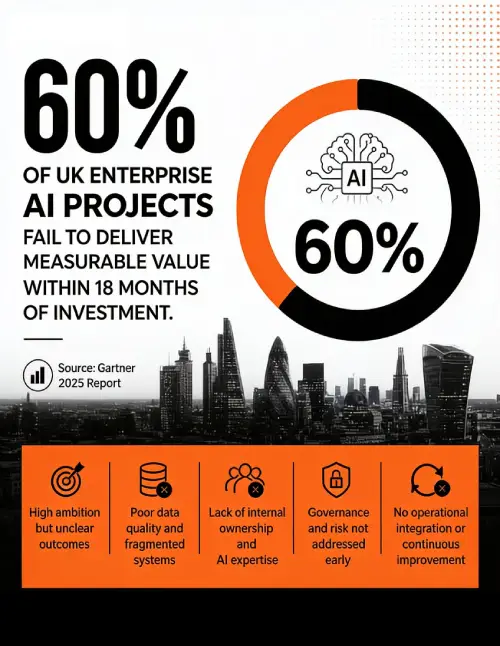
According to Gartner, nearly 60% of enterprise UK AI projects fail to deliver measurable business value within 18 months. Yet the technology itself is rarely the problem. Today’s AI models are capable, accessible and improving at remarkable speed.
The real obstacle lies beneath the surface.
Successful AI doesn’t begin with algorithms. It begins with operational readiness.
Explore our strategic AI solutions for UK SMBs.
The Pilot Worked. So Why Didn't the Business?
Imagine a global bank deploying an AI agent to support regulatory reporting.
The system retrieves financial data, produces reports in minutes rather than days and identifies insights far quicker than manual processes ever could. Leadership sees immediate value and plans an enterprise-wide rollout.
Then progress stops.
The AI still depends on manually curated datasets. Every output requires human validation before it reaches regulators. Reports cannot integrate directly into existing workflows because underlying systems use inconsistent definitions and disconnected data sources.
The AI model performs exactly as designed.
The organisation doesn’t.
This is the story behind many AI projects that never move beyond experimentation.
The Real Problem Isn't AI
Many organisations assume scaling AI requires more sophisticated models, larger investments or additional software.
In reality, AI exposes weaknesses that already exist.
Disconnected systems become more visible.
Poor-quality data becomes more expensive.
Unclear ownership becomes impossible to ignore.
Weak governance becomes a business risk.
AI doesn’t create these problems. It simply reveals them faster than traditional systems ever could.
Organisations that recognise this early build lasting AI capability. Those that don’t often find themselves repeating pilots without delivering meaningful transformation.
Five Reasons UK AI Projects Stall In 2026
1. Strategy Without a Business Problem
Many organisations begin with technology instead of outcomes.
The conversation centres on what AI can do rather than which business challenge deserves solving first.
The strongest AI programmes begin with measurable objectives:
- Reduce reporting time by 50%
- Improve customer response accuracy
- Eliminate repetitive manual processing
- Increase operational efficiency
Technology should support strategy, not define it.
2. Data That Works in Theory, Not Reality
Every AI model relies on trustworthy data.
Unfortunately, many UK organisations still operate with fragmented databases, duplicated records and inconsistent data definitions spread across multiple business units.
A pilot often succeeds because a small technical team spends weeks cleaning and preparing information manually.
At enterprise scale, that level of intervention becomes impossible.
AI is only as reliable as the data foundation beneath it.
Without strong data governance, organisations aren’t scaling intelligence. They’re scaling inconsistency.
3. AI That Never Fits Into Daily Operations
Many AI projects stop at generating recommendations.Few become embedded into operational workflows. Employees still copy information between systems.
Managers still validate outputs manually.
Teams continue switching between disconnected applications.
The result is an AI solution that creates interesting insights but very little operational change.
Successful AI isn’t measured by model accuracy.
It’s measured by whether people naturally use it as part of their everyday work.
4. Governance Arrives Too Late
Governance is often treated as the final checkpoint before deployment.
It should be one of the first conversations.
Questions around data privacy, regulatory compliance, explainability and accountability cannot be added once systems are already built.
As autonomous AI agents become more common, governance becomes even more critical.
Employees need confidence that AI decisions are transparent.
Leaders need assurance that sensitive information remains protected.
Without clear governance, organisations create hesitation instead of trust.
5. Nobody Owns AI After Launch
Many businesses assign responsibility for AI implementation to a project team.
Once deployment finishes, ownership quietly disappears.
AI requires continuous improvement.
Models evolve.
Business processes change.
Data quality fluctuates.
Without operational ownership, even successful AI solutions gradually lose relevance and business value.
Scaling AI isn’t a project.
It’s an operational capability.
Learn more about AI adoption rate in UK – 2026 stats.
What Successful Organisations Do Differently
Businesses that successfully scale AI rarely begin by searching for the newest technology.
Instead, they strengthen the capabilities that allow technology to deliver value consistently.
They invest in high-quality, well-governed data.
They establish clear ownership across business and technology teams.
They embed governance into every stage of implementation.
Most importantly, they focus on solving operational problems rather than showcasing technical innovation.
This shift changes everything.
AI moves from isolated experimentation to becoming part of how decisions are made, services are delivered and operations continuously improve.
Building AI That Lasts
For many UK SMEs, the greatest challenge isn’t adopting AI.
It’s knowing where to start.
Limited budgets, constrained internal expertise and competing business priorities make it tempting to pursue quick wins through standalone AI tools.
But sustainable AI transformation isn’t built through isolated pilots.
It’s built through readiness.
That means understanding whether your data is fit for AI, whether governance is mature enough to support automation and whether your operational processes are prepared to absorb intelligent systems at scale.
These foundations may not generate headlines, but they determine whether AI becomes a competitive advantage or another abandoned initiative.
At NCS London, we’ve seen that the organisations achieving the strongest AI outcomes aren’t necessarily the ones investing the most in technology. They’re the ones investing first in the foundations that allow AI to scale with confidence.
Because in the end, successful AI isn’t about deploying smarter models.
It’s about building a smarter business that those models can actually support.