
Artificial intelligence is transforming how UK businesses work. Employees are using AI to draft reports, analyse data, automate repetitive tasks and improve productivity. While this rapid adoption is encouraging, it has also created a growing business risk that many organisations are failing to address.
That risk is Shadow AI.
Unlike approved enterprise AI platforms, Shadow AI refers to employees using public AI tools without IT approval or governance. It often begins with good intentions, but the consequences can be significant. Sensitive customer information, financial records, proprietary code and confidential business strategies can all be unknowingly exposed through public AI platforms.
For many UK SMEs, Shadow AI is no longer an IT issue. It is a business risk that affects security, compliance, reputation and operational resilience. This is precisely why AI governance solutions UK have become a strategic priority rather than a technical afterthought.
Learn more about why 60% of UK AI projects fail and stall.
Shadow AI Is Already Inside Your Business
Most business leaders believe AI adoption happens through approved projects.
The reality is very different.
Microsoft research shows that up to 71% of UK employees admit to using unapproved AI tools at work. Whether it is generating client proposals, analysing spreadsheets or writing code, employees are increasingly turning to public AI platforms because they are fast and accessible.
The challenge is that these tools often sit completely outside organisational security controls.
IT teams have little or no visibility into:
- What data employees upload
- Which AI tools are being used
- Where business information is stored
- How AI-generated outputs influence business decisions
Without AI governance solutions UK, organisations are effectively allowing sensitive information to flow into systems they neither own nor control.
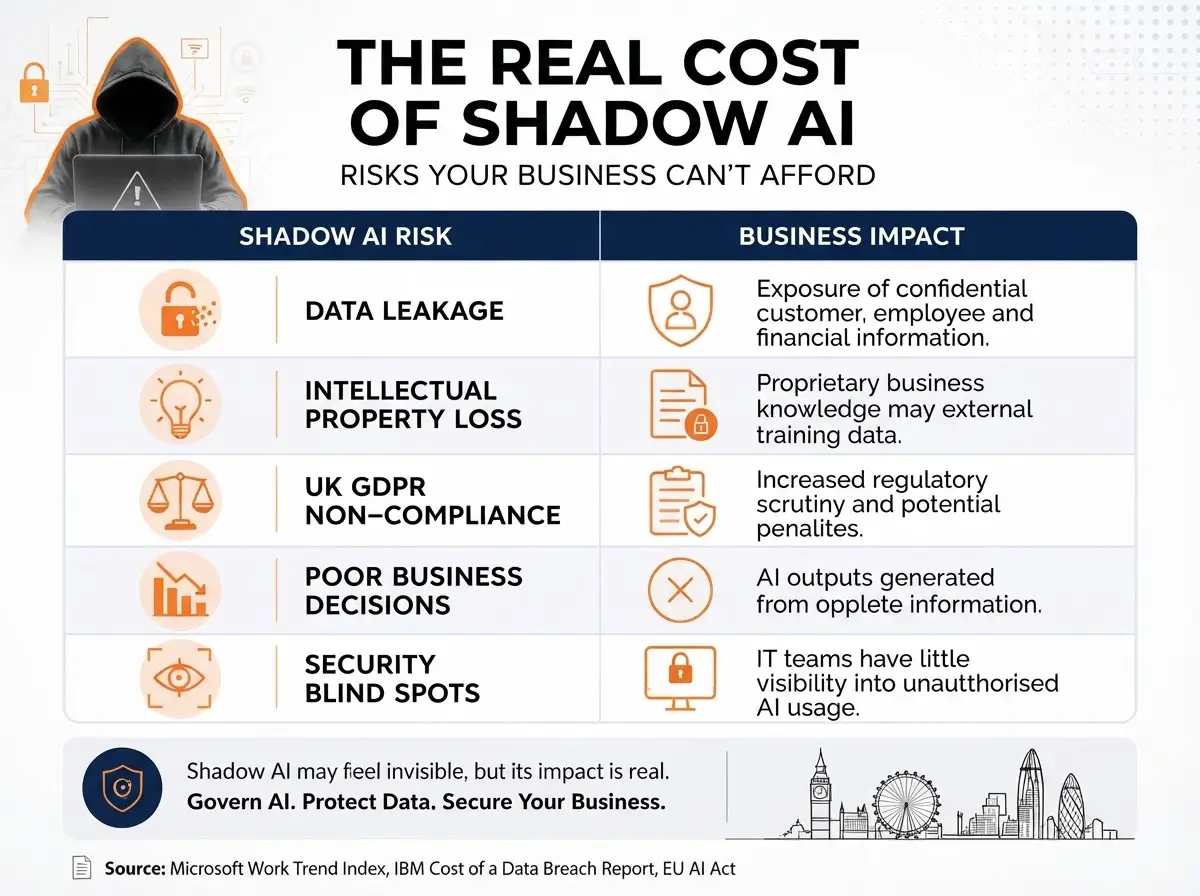
The Real Cost of Shadow AI
Many businesses assume the biggest risk is inaccurate AI-generated content.
In reality, the financial and regulatory consequences are far greater.
| Shadow AI Risk | Business Impact |
|---|---|
| Data leakage | Exposure of confidential customer, employee or financial information |
| Intellectual property loss | Proprietary business knowledge may become part of external AI training data |
| UK GDPR non-compliance | Increased regulatory scrutiny and potential penalties |
| Poor business decisions | AI outputs generated from inaccurate or incomplete information |
| Security blind spots | IT teams remain unaware of unauthorised AI usage across the organisation |
According to recent industry research, organisations with significant Shadow AI exposure experience average data breach costs of $4.63 million, with AI-related incidents increasing breach costs by more than $650,000 per event.
Even more concerning, surveys indicate that one in five UK businesses has already experienced data leakage linked to generative AI.
For SMEs operating with limited security resources, a single incident can disrupt operations, damage customer trust and create long-term financial consequences.
Compliance Risks Are Growing Faster Than AI Adoption
Security is only one part of the challenge.
Regulation is evolving just as quickly.
For UK businesses trading with European customers or operating within EU markets, the EU AI Act introduces significant legal obligations around AI governance, transparency and risk management.
Non-compliance can result in penalties of up to €35 million or 7% of global annual turnover, depending on the severity of the violation.
Perhaps the most important point for business leaders is this:
Claiming that an employee independently installed or used an unauthorised AI tool is not considered an acceptable defence.
Organisations remain accountable for how AI is used across their business.
This makes AI governance solutions UK essential not only for security but also for regulatory readiness.
Why Shadow AI Happens
Most employees are not trying to bypass company policies.
They are simply trying to work more efficiently.
Shadow AI typically emerges when organisations:
- Have no approved AI platform for employees
- Lack clear AI usage policies
- Provide little employee education on AI risks
- Delay governance until after AI adoption has already begun
- Treat AI as an IT initiative instead of a business capability
When these gaps exist, employees naturally seek their own solutions.
Unfortunately, convenience often comes at the expense of governance.
How UK SMEs Can Reduce Shadow AI Risks
The objective should never be to ban AI.
It should be to enable safe and responsible adoption.
An effective AI governance strategy should include:
- Establishing approved AI platforms for business use
- Creating clear AI usage policies aligned with UK GDPR and industry regulations
- Classifying sensitive data before employees interact with AI systems
- Monitoring AI usage across the organisation
- Training employees to recognise security and compliance risks
- Regularly reviewing AI governance as regulations evolve
Most importantly, governance should be embedded before AI scales across the organisation, not after problems emerge.
This proactive approach allows businesses to unlock AI’s productivity benefits while reducing unnecessary operational and regulatory risk.
Explore our AI strategy consulting services for UK SMBs.
Governance Is Becoming a Competitive Advantage
Many organisations still view governance as something that slows innovation.
In reality, the opposite is true.
Businesses with strong governance frameworks adopt AI more confidently because employees understand which tools to use, leaders trust AI-generated outputs and security teams maintain visibility across the organisation.
Rather than limiting innovation, governance creates the foundation for scalable and responsible AI adoption.
As AI continues to become embedded in everyday business operations, organisations that establish these foundations today will be significantly better positioned to compete tomorrow.
Final Thoughts
Shadow AI is not a future problem. It is already influencing how employees work across thousands of UK businesses.
Ignoring it increases the likelihood of data leakage, regulatory breaches and costly operational disruption. Addressing it early creates a safer path towards enterprise-wide AI adoption.
For many SMEs, however, building internal AI governance capabilities can be difficult. Limited budgets, lean IT teams and competing priorities often make it challenging to develop a practical roadmap.
This is where an experienced technology partner can make a meaningful difference.
NCS London works with UK SMEs to develop practical AI governance solutions UK that balance innovation with security, compliance and operational efficiency. Rather than encouraging AI experimentation without direction, NCS London helps businesses build the governance, data foundations and implementation strategies needed to adopt AI with confidence, regardless of team size or budget.
Because sustainable AI transformation is not defined by how quickly you adopt AI. It is defined by how safely, responsibly and effectively you scale it.