



Recent data from the Office for National Statistics (ONS) reveals a striking paradox across the UK corporate landscape. Artificial intelligence has officially crossed into mainstream usage, with 35% of businesses employing at least one AI tool.
Yet, beneath this headline growth lies a sobering reality: almost three-fifths of those organizations are merely using AI to tinker with existing operations. Rather than redesigning products, services, or core business models, AI is largely being relegated to the periphery, completing isolated administrative tasks while the complex workflows that genuinely drive growth remain entirely untouched.
For CFOs, CIOs, and CEOs, this is more than an interesting data point, it is a flashing red warning light.
Most UK enterprises are treating artificial intelligence like a cosmetic software upgrade rather than an operational re-engineering project. They are bolting 2026 intelligence onto 20th-century workflows, confining advanced large language models to superficial administrative tasks. Meanwhile, over 50% of employees are actively utilizing AI tools off-the-books to solve daily friction points.
If your staff are swimming in the deep end through unmanaged shadow usage while your C-suite hesitates at the edge of the pool, your organization faces an urgent strategic deficit.
Learn more about why most UK AI projects stall before they scale in 2026
The Cost of Inaction: What You Lose by Not Deepening AI Adoption
Stalling at the surface level of AI adoption carries a heavy, compounding price tag. When leadership treats AI as a novelty rather than a core business engine, the losses manifest across three critical operational pillars:
- The Innovation Lag: Competitors who move beyond shallow tool usage are re-architecting their core product delivery and supply chains. Remaining static means ceding market share to agile disruptors.
- The Talent Drain: High-performing knowledge workers want to use modern systems. Restricting their access or failing to provide proper enterprise tools forces top talent to seek out forward-thinking employers.
- The Compounding Invisible Risk: Unmonitored employee shadow AI creates severe compliance, data privacy, and intellectual property blind spots. Without formal governance, you carry the risk without reaping the rewards.
Understanding the UK Corporate AI Landscape
To navigate this transition, leadership teams must examine where the market currently stands. The structural reality of AI integration across UK businesses is highlighted below:
| Metric / Dimension | Current Market Reality | Strategic Implication |
|---|---|---|
| Official Adoption Rate | 35% of UK businesses with 10+ employees use at least one AI tool (ONS, 2026). | Adoption is mainstream, but breadth does not equal depth. |
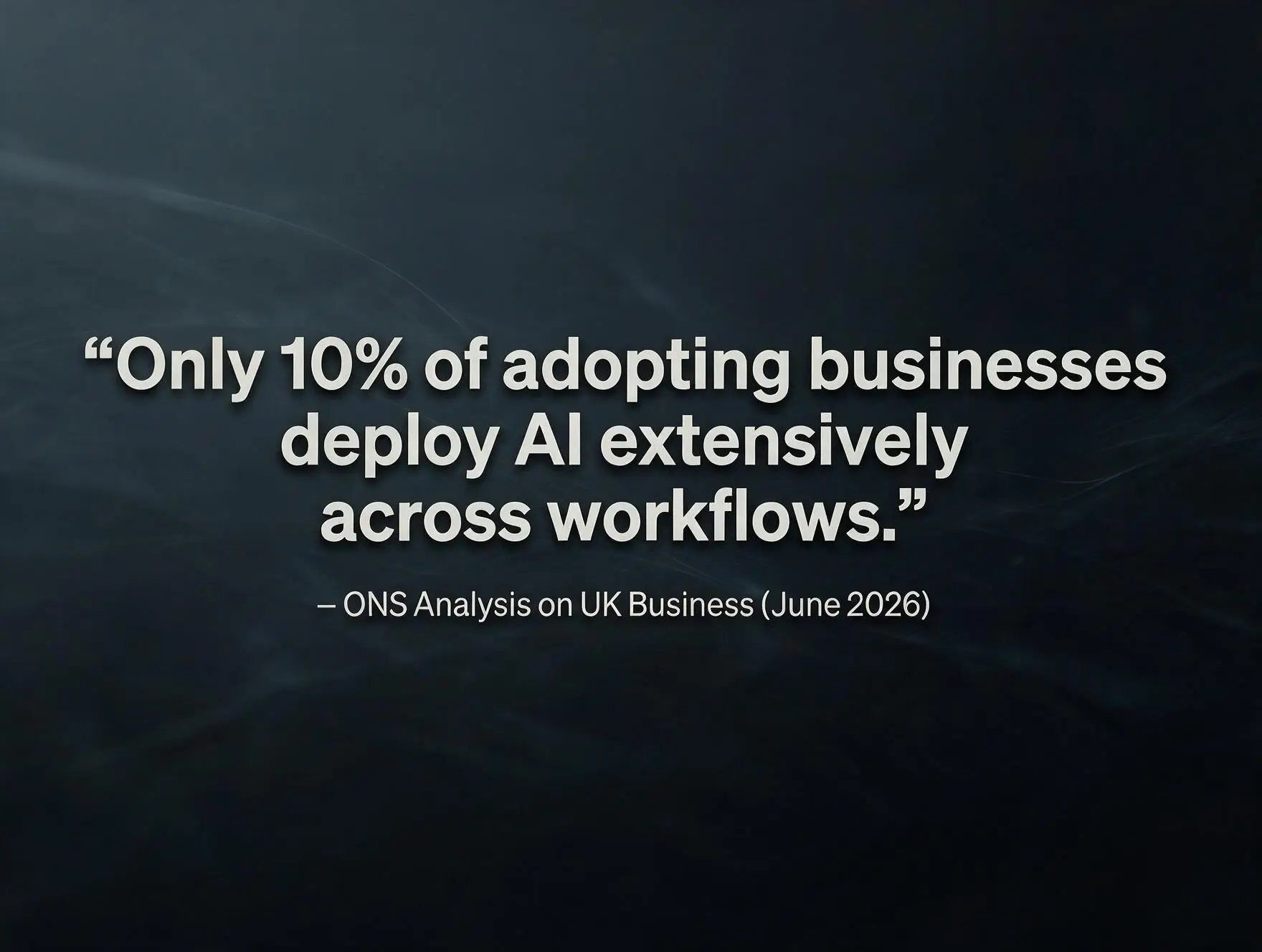
| Deep Deployment Rate | Only 10% of adopting businesses deploy AI extensively across workflows. | A massive competitive vacuum exists for firms willing to operationalize AI. |
| Average Tool Utilization | 1.6 AI technologies per adopting organization (up modestly from 1.4). | Most firms are siloed, relying on isolated point solutions rather than ecosystems. |
| Shadow AI Disconnect | Over 50% of employees use AI for work, often outside central visibility. | Employees are ready for advanced capabilities; internal processes are lagging behind. |
The Three Pillars of Enterprise AI Transformation
Moving past the shallow adoption trap requires a fundamental shift in how leadership approaches technology deployment. True transformation relies on three non-negotiable steps:
1. Process Re-Engineering Over Surface Integration
You cannot achieve enterprise-grade ROI by pasting modern intelligence onto legacy steps designed for a pre-AI world. Winning organizations redesign workflows from the ground up, embedding automated checkpoints and structural validation so that algorithms can safely take on high-value operational authority.
2. Visibility and Trust-Driven Governance
Uncertainty is the primary enemy of enterprise growth. CIOs and CFOs cannot manage what they cannot see. Building institutional trust requires replacing restrictive, fear-based bans with comprehensive visibility frameworks, audit trails, and clear data lineage policies that protect sensitive corporate assets.
3. Systemic Workforce Upskilling
With only a fraction of businesses reporting widespread staff training, a massive capability gap remains. True transformation happens when every department possesses the confidence and structured guidance to apply technology safely to core business challenges.
Major AI adoption roadblocks for UK businesses
1. The Trust Deficit: Why AI Stays on the Edges
According to Daniel Meyer, Chief Technology Officer at Camunda, companies are struggling to move beyond early use cases because a fundamental barrier stands in their way: trust.
“There is a widening gap between the vision for AI and the reality inside most organisations,” notes Meyer. “Companies are failing to realise AI’s potential because they cannot trust it to operate where it matters most.”
The root of the issue isn’t the technology itself, but the processes surrounding it. As Meyer points out, bolting modern intelligence onto workflows designed for a pre-AI world was never going to transform a business trajectory. True advancement requires re-engineering processes around AI, embedding the necessary approvals, audit trails, and guardrails that make it safe to hand algorithms real operational authority.
When errors, bias, or a lack of oversight carry high consequences, governance and operational readiness must evolve alongside model performance.
2. The Blind Spot: Shadow AI vs. Managed Deployment
Compounding the challenge of shallow adoption is a glaring visibility gap. While roughly a third of businesses officially report using AI, more than half of all employees admit they use AI for work or education.
This disconnect highlights a surge in unmanaged “shadow AI.” Scott Pope, Director of Value Advisory at Nexthink, explains that a lack of central oversight is acting as a major brake on wider deployment:
“What holds leaders back is uncertainty. They cannot answer basic questions about how AI is being used across their organisation, whether it is safe, which tools are delivering results and which are quietly creating risk.”
Without clear visibility, organizations cannot accurately determine which use cases deserve strategic expansion and which demand stricter controls.
Learn more about Shadow AI’s impact on UK businesses.
3. The Readiness Bottleneck: Skills and Headcount
Technology adoption can only scale as fast as the workforce using it. At present, workforce readiness is lagging behind hardware and software deployment: only 11% of businesses report that more than half their staff have received formal AI training. Unsurprisingly, firms recognizing this lack of expertise as a barrier are investing heavily in retraining their people, proving that deeper utilization hinges entirely on employee confidence.
Interestingly, despite fears of widespread displacement, the labor market impact remains remarkably modest. Among businesses using AI to streamline operations, 63% reported zero change in headcount, with only 6% noting a reduction. Right now, AI is fundamentally changing how work gets done, not cutting the overall size of organizations.
The Road Ahead
The latest figures make one thing clear: AI is no longer an experimental novelty for UK businesses. However, moving past isolated tasks and into high-value operations will require more than just downloading new software.
The next stage of growth belongs to the organizations that master trust, visibility, skills, and process readiness, turning artificial intelligence from a superficial admin assistant into a trusted engine for core business transformation.
Partnering with NCS London For AI Consulting Services
Navigating the gap between surface experimentation and deep operational transformation requires a trusted advisor who understands both legacy infrastructure and advanced digital architecture.
As a premier AI technology consulting partner, NCS London helps executive leadership teams bridge the divide. By combining deep database expertise, robust cloud strategies, and tailored AI governance frameworks, we help organizations move past the shallow adoption trap.
We don’t just implement tools, we re-engineer your operational plumbing, providing the visibility, auditability, and strategic depth required to turn artificial intelligence into your organization’s ultimate competitive advantage.
Ready to move beyond surface-level AI and unlock measurable ROI? Connect with the NCS London team today to schedule your comprehensive Data Maturity Assessment.


