
For years, the business case for artificial intelligence has been built around forecasts.
Productivity will improve. Automation will accelerate. New business models will emerge. Entire industries will be reshaped.
Now, the evidence is becoming harder to ignore.
The AI Boom in the UK is beginning to appear not only in technology adoption statistics and boardroom investment plans, but also in the country’s economic data.
The UK economy grew by 0.4% in Q2 2026, according to the Office for National Statistics.
Almost half of that expansion came from the information and communications sector. Within the sector, computer programming, consultancy and related activities increased by 3.7%, following a 3.8% rise in the previous quarter.
The ONS does not classify all of this activity as AI. However, the growth in technology services, alongside increased investment in computing infrastructure, provides a strong signal that the AI Boom in the UK is moving from technological enthusiasm towards economic impact.
For business leaders, that changes the question.
It is no longer simply, Should we adopt AI?
It is:
How do we ensure our business benefits from the AI-driven economy rather than simply watching it happen?
Learn more about AI governance solutions in the UK.
The AI Boom Is Showing Up Beyond Software
One of the most significant developments is that the AI Boom in the UK is not limited to companies building AI models.
It is creating demand across the technology ecosystem.
Businesses need:
- More computing capacity
- Better data infrastructure
- Cloud and hybrid infrastructure
- Cybersecurity controls
- AI-ready applications
- Integration capabilities
- Data engineering
- Specialist technology skills
Recent economic data points to this wider infrastructure effect. Business investment increased in Q2, while investment in information and communications technology and computer hardware showed notable strength. Reuters reported that economists viewed the increase in computing-related investment as evidence that businesses are building the infrastructure required to support AI.
This matters because AI is increasingly becoming an infrastructure story, not just a software story.
A business cannot build an effective AI capability on top of fragmented data, outdated systems and poorly connected processes.
The AI Boom Is Showing Up Beyond Software
One of the most significant developments is that the AI Boom in the UK is not limited to companies building AI models.
It is creating demand across the technology ecosystem.
Businesses need:
- More computing capacity
- Better data infrastructure
- Cloud and hybrid infrastructure
- Cybersecurity controls
- AI-ready applications
- Integration capabilities
- Data engineering
- Specialist technology skills
Recent economic data points to this wider infrastructure effect. Business investment increased in Q2, while investment in information and communications technology and computer hardware showed notable strength. Reuters reported that economists viewed the increase in computing-related investment as evidence that businesses are building the infrastructure required to support AI.
This matters because AI is increasingly becoming an infrastructure story, not just a software story.
A business cannot build an effective AI capability on top of fragmented data, outdated systems and poorly connected processes.
AI Growth in UK Businesses Is Creating a New Competitive Divide
The AI growth in UK businesses is unlikely to benefit every organisation equally.
The emerging divide will not simply be between companies that use AI and those that do not.
It will be between organisations that can operationalise AI and those that remain stuck in experimentation.
That distinction is critical.
A company might have employees using generative AI tools every day. It might have several successful pilots. It might even have an AI strategy documented on paper.
None of these necessarily creates competitive advantage.
The real value appears when AI becomes embedded into business processes.
Consider three businesses using AI:
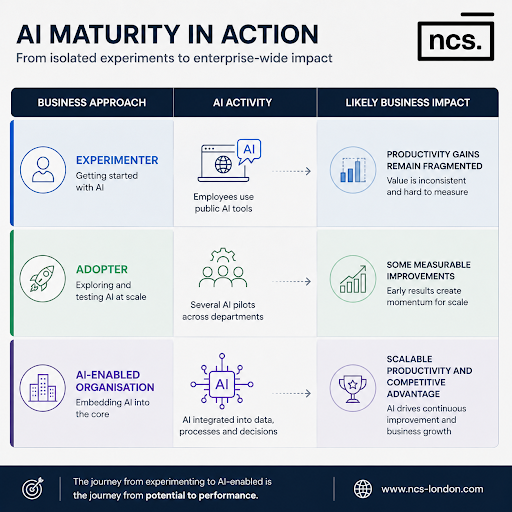
The third category is where the AI Boom in the UK becomes strategically significant.
The Problem: Investment Is Moving Faster Than Readiness
There is an important paradox emerging.
Businesses understand that AI matters. Investment is increasing. Technology infrastructure is expanding. Yet many organisations still struggle to move AI initiatives into production.
Why?
Because technology adoption exposes weaknesses that already exist.
Poor data becomes an AI problem.
Disconnected applications become an AI integration problem.
Weak governance becomes an AI risk problem.
Skills shortages become an AI implementation problem.
Unclear business priorities become an AI ROI problem.
This is why the AI adoption in UK conversation needs to mature.
The question should not be how many AI tools an organisation has deployed.
The question should be whether the organisation is capable of turning AI investment into measurable business outcomes.
How AI Is Growing in UK Businesses Will Depend on the Foundations
The how AI is growing in UK businesses question is particularly important for SMEs.
Large enterprises can afford dedicated AI teams, specialist consultants and substantial infrastructure investments.
SMEs often cannot.
They may have a small IT team managing everything from cybersecurity and cloud infrastructure to business applications and user support. Adding AI strategy, data preparation, governance and implementation to that workload creates a significant capability challenge.
This does not mean smaller businesses should wait.
It means they need to be more selective.
An SME should identify where AI can create meaningful value before investing in technology at scale.
Good starting points might include:
- Automating repetitive administrative processes
- Improving customer service response times
- Extracting insights from operational data
- Supporting sales forecasting
- Automating document-heavy workflows
- Improving internal knowledge access
- Enhancing management reporting
The objective is not to implement AI everywhere.
It is to implement it where the economics make sense.
The Next Phase of the AI Boom Will Be About Execution
The first phase of AI adoption was about experimentation.
The next phase will be about execution.
That requires business leaders to connect four components:
Strategy + Data + Technology + People
Remove one, and the business case weakens.
A sophisticated AI platform cannot compensate for poor-quality data.
Excellent data cannot create value without an appropriate use case.
A strong strategy will fail if employees cannot adopt the new processes.
And enthusiastic employees cannot scale AI safely without governance.
This is why the AI Boom in the UK should be viewed as a business transformation opportunity rather than a technology purchasing cycle.
Read more about why most UK AI projects fail
What Should C-Suite Leaders Do Now?
Executives do not need to predict which AI technology will dominate five years from now.
They need to build an organisation capable of adapting as the technology changes.
That means taking five practical steps.
1. Identify the business problems first
Start with revenue, cost, productivity, customer experience and operational efficiency.
Then determine where AI can make a measurable difference.
2. Assess AI readiness
Examine the quality of your data, existing systems, infrastructure, cybersecurity, governance and internal skills.
3. Prioritise use cases
Do not launch ten AI projects simply because competitors are doing so.
Rank opportunities by business value, complexity, risk and implementation effort.
4. Build governance alongside innovation
AI governance should not be an approval process added at the end.
It should establish how data, models, employees and AI-generated decisions are managed from the beginning.
5. Measure outcomes, not activity
The number of AI pilots is not a KPI.
Neither is the number of employees given access to a chatbot.
Measure productivity gains, revenue impact, cost reduction, accuracy, customer outcomes and time saved.
The Latest AI News in UK Businesses Has a Message for Leaders
The latest AI news in UK businesses is encouraging, but executives should resist interpreting economic momentum as a guarantee of individual business success.
The UK economy is benefiting from growth in technology-related activity and increased investment in computing capability. Computer programming and consultancy activity has recorded consecutive quarterly increases, while information and communications has been a significant contributor to economic growth.
But economic momentum creates an opportunity. It does not create a strategy.
The businesses that benefit most from the AI Boom in the UK will be those that translate investment into operational capability.
They will know which processes to automate.
They will understand which data can support AI.
They will establish appropriate governance.
They will equip their people to work alongside intelligent systems.
And they will measure whether the investment actually improves the business.
The Strategic Opportunity for UK Businesses
The AI Boom in the UK represents something bigger than another technology cycle.
It could become a structural shift in how British businesses operate, compete and grow.
The infrastructure investment happening today is creating the foundation. The next challenge is turning that foundation into business value.
For UK SMEs in particular, that requires a pragmatic approach. Limited budgets and lean internal teams make indiscriminate AI investment difficult to justify. The smarter approach is to understand readiness, prioritise high-value opportunities and build a roadmap that can scale as the business gains confidence.
This is where NCS London’s AI strategic solutions can play a strategic role.
As an AI strategy and transformation partner for UK businesses, NCS London helps organisations move beyond AI experimentation towards practical, governed and outcome-driven adoption.
Our approach brings together AI strategy, data readiness, technology foundations and implementation planning, helping SMEs make informed investment decisions without requiring them to build large internal AI teams.
The AI Boom in the UK is creating an opportunity.
But opportunity alone does not create growth.
The winners will be the businesses that turn AI from something they experiment with into something their organisation knows how to execute.
FAQs
es. Recent ONS data shows strong growth in information and communications activity, including a 3.7% quarterly increase in computer programming, consultancy and related activities. AI cannot be isolated from all of this activity, but the growth coincides with increased investment in computing infrastructure that economists have linked to AI demand.
AI is moving beyond individual productivity tools towards applications in automation, data analysis, customer service, forecasting, software development and decision support. The next stage is integrating these capabilities into core business processes rather than running disconnected AI experiments.
For SMEs, the AI boom creates an opportunity to improve productivity and compete with larger organisations without necessarily matching their technology budgets. The priority should be identifying high-value use cases, assessing AI readiness and adopting solutions that deliver measurable business outcomes.
Businesses should assess their data quality, infrastructure, cybersecurity, governance, internal capabilities and business processes. They should then prioritise AI use cases according to potential value, implementation complexity and risk before committing significant investment.
No. AI is an enabling technology rather than a guaranteed source of growth. Businesses create value when they connect AI investment to specific commercial objectives, integrate AI into workflows, prepare their data and equip employees to use the technology effectively. The AI Boom in the UK creates the opportunity, but execution determines the outcome.